
2027 Apologetics (Advanced) Network
- Image
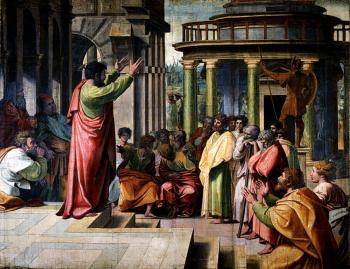
What did the Apostle Paul do when Pre-Christian Europe was pagan, relativistic, and pluralistic? He did apologetics among his contemporaries; Paul went to the Jews, arguing from the Old Testament Scriptures that Jesus was the Christ, and to the pagan Greeks, using their literature and cultural artefacts to argue that the 'unknown God' has been revealed and proclaimed in Jesus.
21st-century Europe is in a state very similar to Paul's time and needs gifted apologists who can demonstrate that Christianity is true and relevant. Therefore, the vision of the European Apologetics Network is to train a new generation of apologists who can stand in today's marketplace of ideas in the way that Paul did in his generation. Our desire is to develop apologists who will testify to the truth of the Gospel with wisdom, versatility, and courage in their efforts to persuade their contemporaries.
The Advanced Apologetics Network has been formatted to function as an interactive learning experience. Based on participants’ feedback, the Network format will provide three essential components to support apologetic endeavour in Europe:
- Knowledge: Network participants will learn from leading apologists, philosophers, and scientists, being equipped to engage with some of the crucial issues of our time with fresh perspectives.
- Skills: Our format includes an emphasis on practical skills development. Participants will be challenged to put into practice what they've learned in interactive formats, including developing arguments and content ideas.
- Community: By joining the Network, participants become part of a community of apologists. The Network design will provide opportunities to connect with like-minded Christians, exchange know-how, and work together on future collaborations. We envision that this community will continue throughout the year online.
What Network Participants Are Saying
- "Being at ELF was so helpful for me because I had the ability to learn from faithful and experienced leaders. I learned how to approach unbelievers in a friendly and biblically faithful way in cultural apologetics. Also, I learned valuable ways to equip church members to share the gospel with their friends in their neighborhoods and workplaces." - Zsolt Kapitany, Pastor of Pestszentimre Baptist Church, Hungary
- "Being at the European Leadership Forum is so exciting and encouraging. I had the amazing opportunity to meet experienced academics and apologists, gifted speakers, devoted Christians, and faithful brothers and sisters in Christ. The information and knowledge I received through the Apologetics Network are of great help to me, challenging me to invest in my training, abilities, and calling."
- Teodor Colda, Vice Academic Dean of Baptist Theological Institute, Romania - "The European Leadership Forum has become like an elder brother who holds the hand of a toddler and teaches them to work. I started experiencing the benefits of the Forum last year with the Year-Round Mentoring program, where I was able to share the challenges of my context with my mentor; he helped me to find tangible solutions to my problems. I have now received encouragement from leaders from all over the world in the Apologetics Network and can say that I am now encouraged to keep serving God, knowing that I am not alone."
- Danson Ottawa, National Coordinator of Africa Center for Apologetics Research, Kenya
Applicants should be those with evangelistic or apologetic gifts who have first attended the European Apologetics Foundational Network and the European Evangelism Network. The purpose of the Network is to train, mentor, equip, and resource those evangelists and apologists who are seeking to communicate the Gospel in their local communities. Prior preparation will be set for all applicants.
Network Leadership

Network Speakers
Andrew Fellows was appointed pastor of a church in Bradford, West Yorkshire in 1988 where he served for seven years. In 1995 his family moved to the English branch of L’Abri Fellowship, where they lived and worked for 21 years. From 2011 to 2016 Andrew was the chairman of L’Abri International.… Read more

Alexander Fink is Director of the Institute for Faith and Science (Institut für Glaube und Wissenschaft) in Marburg, Germany (www.iguw.de). He studied physics at Bayreuth and St. Andrews (UK) universities and received his PhD at the Institute for Biophysics at… Read more

Stefan Gustavsson is a member of the European Leadership Forum Steering Committee. He is the director for Apologia – Centre for Christian Apologetics and makes his home in Stockholm. He was the founding general secretary for 16 years of the Swedish Evangelical Alliance. Stefan travels widely… Read more

Sharon James studied history at Cambridge University, theology at Toronto Baptist Seminary, and has a doctorate from the University of Wales. Sharon is married to Bill, who is Principal of London Seminary. They have two grown-up children and eight grandchildren. She has taught history in the UK… Read more
Mihail Stefanov is the assistant pastor at Crossroad’s Church Sofia (crossroadchurch.bg) and the founder of Culture and People (cultureandpeople.eu) – an international consulting firm helping global business leaders transform the culture of their organizations. He has a deep passion for… Read more

Pasi Turunen, theologian (M.Th), author, blogger, and apologist, has been working as a Christian radio broadcaster for over 30 years. He studied theology at Helsinki University, where his master’s thesis dealt with Jewish views on resurrection in the intertestamental Jewish literature. Turunen… Read more
Network Programme
Sunday, 23 May
This lecture argues that contemporary Western culture has not abandoned revelation but inverted it, replacing divine authority with the sovereignty of the self and the logic of 'my truth'. It contrasts the biblical pattern of revelation, where truth comes from beyond us and demands our submission, with a cultural model in which truth is filtered, curated, and authenticated by personal preference and experience. Through four case studies–new spiritualities, the quiet revival, conspiracy culture, and artificial intelligence–it shows how this 'Great Revelation Inversion' has reshaped both private belief and public life. Finally, it contends that Christian apologetics must recover confidence in God's objective, authoritative self-revelation in Christ and Scripture as the only revelation capable of confronting, correcting, and transforming the self rather than merely reflecting it.
Stories are not merely entertainment — they are among the most powerful ways in which human beings make sense of themselves and the world. We inhabit stories about who we are, what has gone wrong, what a good life looks like, and where history is going. Jesus understood the persuasive power of narrative profoundly: rather than only explaining truth, he repeatedly told stories that invited His listeners to enter a different vision of reality and discover themselves within it.
Inspired by His example, in this session, participants will learn how to discover and analyse the master narratives that shape secular culture and individual worldviews. They will also practise using stories in apologetic situations — to expose hidden assumptions, reframe questions, and invite people to see Christianity not merely as a set of propositions, but as a compelling account of reality in which they might find themselves.
Monday, 24 May
In Europe, a Gospel presentation is naturally met with objections and questions – and that is not something to be avoided. The New Testament says, 'Let your conversation be always full of grace, seasoned with salt, so that you may know how to answer everyone.' (Col 4:7) As apologists, we are called to grow in the art of answering questions. In this session, we will both look at principles that can guide us in developing answers and tackle some of the most common questions we face.
In a cultural context that couldn't care less about what Christianity says about marriage, how can we, as followers of Christ, make a loving case for biblical marriage? How should we respond to personal challenges that ask: “What would you say if your own child came to you and said he/she is gay and wants to marry?” In this talk, we learn that good arguments are important, but arguments alone are not enough. In addition to good preparation, we need to know how to present our case in a winsome manner. We explore how to manoeuvre through the minefield of red herrings, mischaracterisation, and personal attacks in arguments against traditional marriage with grace and truth.
Tuesday, 25 May
Often Christians do not know how to respond to naturalistic arguments against the existence of God. Do you have to understand the function of the bacterial flagellum to be able to discuss faith with proponents of naturalism, or are there easier ways to challenge their premises? Which questions can help? What arguments can a non-scientist use to show the plausibility of the Christian faith? This session demonstrates that Christians can have confidence that the Gospel is still true in a world dominated by science and offers tools for responding to scientific claims against the existence of God.
When you control the language, you control the debate. Words such as identity, orientation, inclusion, oppression, diversity, and many more have been redefined. They are often used in a way that denies creation order and defies divine design. We will examine ways in which language is used to manipulate emotion and shut down discussion. Christians can be confident in an age of confusion. We will conclude with five suggestions to help believers to detect false ideas and respond with grace and truth.
Wednesday, 26 May
Welcome to the Relentless Podcast! The final day is entirely allocated to practice and method, focusing on an interactive role-play activity. In this first session, participants take on the role of Christian apologists, invited as guests to the Relentless Podcast live show. There they are grilled by the two hosts on a variety of difficult topics.
Welcome to the Relentless Podcast! The final day is entirely allocated to practice and method, focusing on an interactive role-play activity. In this second session, participants engage in feedback and brainstorming on improving their communication strategies, arguments, and overall defence of the Christian position.